
Commodity trading news and analysis: Understanding commodities risk


Get a handle on commodities with commodity trading news and analysis. Discover how to implement a strategy that considers everything from political events to market sentiment to paint a clear picture of the current market.
A commodities risk analysis gives traders insights into the commodities market. By researching the markets, reading news events, analyzing supply and demand, and checking price charts, traders can better understand the markets and predict future price swings.
Whether you’re trading gold, silver, oil, or gas, a commodities analysis can help you to identify the best times to enter and exit a trade, as well as the best places for stop loss and take profit orders. It’s not an exact science, but it will give you more knowledge of the market and increased confidence when predicting its direction.
Content
- What is commodity trading news and analysis, and why does it matter?
- Types of news that impact commodity trading and commodities analysis
- Commodities risk analysis: Understanding risk in commodity trading
- How to perform a commodity trading news and commodities analysis
- Best tools and sources for commodity trading news and analysis
- Common mistakes in commodity trading news and commodities analysis
- Frequently asked questions about commodities analysis
- Final thoughts
What is commodity trading news and analysis, and why does it matter?
Where is the market going? Will the support and resistance lines break? How will recent geopolitical events impact the price? These are all key questions that commodity trading news and analysis could answer.
What are commodities?
Commodities are the raw materials that keep the wheels of the global economy turning. These materials are separated into hard and soft commodities:
- Soft commodities: Agricultural goods like wheat, soy, and rice—anything that can be produced or harvested. These goods are then turned into consumer products, but they are perishable and can be affected by weather or poor harvests, creating market volatility.
- Hard commodities: Resources that are extracted or mined, including gold, silver, oil, and gas. While precious metals like gold and silver are generally less volatile because they are not impacted by weather, oil and gas are highly sensitive to geopolitical events, supply chain disruptions, and changes in global demand. These factors often make oil and gas some of the most actively traded and closely analyzed commodities in the world.
Both hard and soft commodities can be traded through CFDs, providing opportunities to profit from price movements without owning the underlying asset.
Traders buy and sell physical commodities or CFDs with the aim of profiting from future price movements.

The role of market-moving news
The primary concern of commodity trading news and analysis is how the market will react to certain events. For gold and silver, prices tend to increase when the value of the US dollar decreases, making these safe-haven assets more viable in times of economic strife.
For most commodities, however, it’s all about supply and demand. Poor harvests, mining shortages, and factors like riots, war, and political instability, which disrupt global supply chains, impact supply. When supply drops, demand increases, and prices rise accordingly.
Demand is also impacted by consumer preferences, consumer income, and a greater industrial need. If more people start eating products made from wheat or manufacturers demand more gold and silver for electronics and medical devices, the price goes up.
A commodity market trend analysis will consider all of these factors.
To strengthen your analysis, consider using the Moving Averages indicator, which is particularly effective for identifying market trends in commodities.
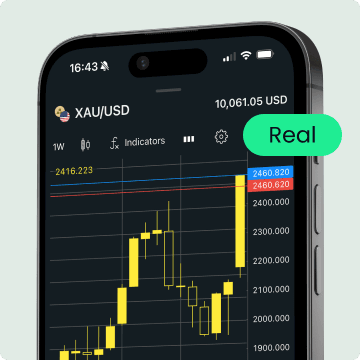
Exness Trade app
Trade with confidence anytime, anywhere.
Types of news that impact commodity trading and commodities analysis
Performing commodity trading news and analysis can be challenging because the key news events don’t always relate directly to the commodities you’re tracking. That’s why traders will look beyond the headlines.
Geopolitical news and events
The first quarter of 2025 provided a prime example of how global events can impact commodity prices.
A rush of tariffs led to gold prices hitting a record high of 3,000 USD. Traders panicked, and as stock markets lost money and bonds became less viable, many chose to add gold—seen as a store of value and a hedge against inflation—to their portfolios. The trade deals that followed led to market corrections and provided some stability.
In the preceding years, the war in Ukraine and the resulting sanctions created massive supply chain disruptions. Russia and Ukraine are two of the world’s largest wheat producers, so the resulting disruption and panic led to a 28% increase in the price of wheat.
Geopolitical events like conflicts or trade disputes can significantly impact commodity prices. To learn how to navigate volatile markets, check out our article “Trading Strategies During Conflict: How to Trade in 2025.”

Economic indicators
Traders keep a watchful eye on interest rate changes. If they change to the point that bonds, savings accounts, and other high-yield investments become more viable, commodities usually fall. Conversely, if there is little to be gained from those traditional investments, traders turn to hard commodities like gold and silver.
The price of precious metals also rises during inflationary times. These metals are seen as a hedge against inflation—when the US dollar weakens, the demand for them increases.
Gross domestic product (GDP) must also be included in a commodities analysis. GDP measures a country’s output, including goods and services. A high GDP indicates a flourishing economy, leading to greater manufacturing output and consumer purchases, which in turn will increase the demand for raw materials.
Weather and natural disasters
One bad season can decimate a crop, and if it occurs across multiple regions or results from a major event like a natural disaster, supply will drop, demand will increase, and commodity prices will rise.
Therefore, a commodities risk analysis should account for weather events, natural disasters, and the effects of climate change.
Industry-specific reports
Announcements from agricultural bodies such as the USDA (US Food and Drug Administration) can alter the annual yield, while announcements from OPEC (The Organization of the Petroleum Exporting Countries) regarding oil may lead to a surge or reduction in output. If more oil enters the market, the price falls; if supply is cut, the prices rise.
Commodities risk analysis: Understanding risk in commodity trading
Risk is inherent in every market, and while there are no guarantees, a commodities risk analysis can mitigate some of that risk.
Types of risks: Market, geopolitical, operational
- Market risk is the uncertainty surrounding the market. It includes factors such as unexpected price movements, changes in exchange rates, price volatility, and the type of events that triggered “Silver Thursday”—a market event in the 1980s when two brothers cornered the market, created scarcity, and drove silver prices to record highs.
- Geopolitical risks include the aforementioned trade tariffs and trade deals, as well as policies and regulations that impact supply and demand and change market sentiment. Any event or announcement that impacts the supply chain will alter a commodity’s price, even if they aren’t directly related.
- Operational risks span everything from complications that reduce mining output to pests that damage crops. Operational changes can also increase supply, such as technological improvements that make it easy to increase agricultural or mining yields.
Volatility and price swings
In a sense, all markets are subject to supply and demand. For instance, a stock’s price may rise or fall according to consumer interest. However, commodities are more susceptible, making them highly volatile.
Production costs, natural disasters, geopolitical events—many factors can increase or decrease a commodity’s price. For instance, the threat of war may increase the price of oil, as higher demand is predicted, while increased output could send the price in the other direction.
A commodities risk analysis aims to account for such volatility.

Managing risk with hedging and diversification
Commodities give traders a chance to diversify their portfolios and hedge against inflation.
They are volatile, but they also move inversely to the US dollar and alternative investments. By trading gold, traders can prepare for times of economic strife; by spreading their options across multiple commodities, they can prepare for various outcomes.
Hedging typically involves taking an offsetting position to reduce potential losses. For example, a trader who holds a large amount of oil contracts may open a short position on the same asset to limit downside risk if prices fall. Similarly, options contracts can be used to lock in future prices and protect against sudden market swings.
Diversification, on the other hand, means allocating capital across several commodities—such as gold, silver, oil, and agricultural products—so that the performance of one market does not overly impact the entire portfolio. Combining commodities with other asset classes, such as indices or forex pairs, can also help balance risk exposure and improve long-term stability.
Ultimately, both hedging and diversification work best when paired with a solid commodities risk analysis and a clear trading plan that defines entry and exit points.
How to perform a commodity trading news and commodities analysis
You know the factors that influence commodity trading news and analysis, but how do you actually conduct such an analysis?
Using fundamental analysis
A fundamental commodities analysis evaluates intrinsic value by considering supply and demand factors.
If we use crude oil as an example, a trader may analyze current inventories and compare them to previous inventories to determine whether the supply will go up or down. If the available supply is much lower than usual, and they predict an increase in demand, they may judge that demand will soon outstrip supply, thus sending the price higher.
How they predict demand is dependent on the factors discussed above. In this example, they could predict an increase in demand resulting from political tensions leading to higher manufacturing output and greater military demand.
Applying technical analysis
Although commodities are affected by a myriad of factors, the prices usually form trending patterns. Traders can use technical commodities analysis to study charts, spot patterns, and determine the price’s direction.
A commodity technical analysis may include:
- Candlestick charts and bar charts for simple visualization.
- Trend, resistance, and support lines to plot movement.
- Technical indicators like Moving Averages or Stochastic Oscillators to clarify price data.
All of these tools and more are available to Exness users on the Exness Terminal, Exness Trade app, and MetaTrader platforms. You can also select your preferred charts and timeframes before adding technical indicators. You can use all of these tools on all commodities currently being traded on Exness.

Combining both approaches
Technical and fundamental analyses adopt very different approaches, but they both have the same goal and can be used in combination to better understand the market.
A technical analysis can highlight key price trends and suggest certain breakouts, while a fundamental analysis can confirm or challenge these breakouts and gauge the extent to which the price will increase or fall.
For example, a trading pattern may hint that wheat is about to break out and reverse from a bearish market to a bullish one. This signal could be confirmed by news indicating reduced supply and increased demand, suggesting that buyers will flood the market and drive up the price.
Used independently, both of these approaches are effective ways to understand the market. In combination, they provide traders with more depth and market insights, allowing them to trade with confidence.
Best tools and sources for commodity trading news and analysis
Traders utilize various tools and platforms to help them when conducting commodity trading news and analysis.
Top websites and platforms
News platforms like Bloomberg and Reuters can inform traders about key geopolitical events. Investor-focused platforms like Trading Economics and Investing.com may be a better starting point for novice traders, as they focus more on direct influences and may provide the trader with insights into how certain announcements or events will impact the market, while also outlining the changes that have already taken effect.
News aggregators and real-time alerts
It’s not practical to plant yourself on a news site and keep hitting the “refresh” button. At the same time, if you wait to hear about an event on TV or through the rumor mill, it may be too late to act.
Instead, use Google Alerts to receive announcements relative to your chosen topic. Simply click here and enter the topic in the search bar. You can then click “Create Alert” to receive notifications when relevant stories are published.
If you’re trading gold, for instance, use alerts like “gold” or “gold price”.
Alternatively, use an RSS reader to subscribe to feeds from relevant and trustworthy news sites. Make sure the site publishes original content quickly and doesn’t simply regurgitate what everyone else is saying hours after the news first breaks.
Social media sites like X can also be a good source, provided you follow trusted journalists, bloggers, investors, and websites.

Common mistakes in commodity trading news and commodities analysis
A proper commodities risk analysis won’t do all of the work for you—it’s still possible to make mistakes:
Overreacting to news headlines
News sites chase views. They want click-worthy titles and engaging stories, and that means some of them overreact to certain stories or imply false information.
Context is key. A headline declaring “The market reacts in shock as the price of gold plummets” could have traders rushing to short this precious metal. However, if you read the article and confirm its points, you may discover a minor consolidation that has no bearing on the future price.
Remember that their goal is to get more views and ad clicks, while your goal is to read informative content. These goals don’t always align.
Ignoring long-term trends
The volatility of commodities means that prices can fluctuate heavily from one day to the next. Just because soy dropped a few points in the last hour doesn’t mean it’s in freefall. Zoom out. Look at the bigger picture. That seemingly massive swing could look insignificant in context.
Trading without a plan
Plan everything. Your budget. Your trading goals. Your preferred strategy. Failure to plan could result in reckless trades driven by hope and emotion rather than expectation and facts.
Stay disciplined and patient. Stick to your strategy and wait for the right moment, as opposed to simply trading for the sake of it.
Exness Trade app
Trade with confidence anytime, anywhere.
Frequently asked questions about commodities analysis
What is commodities risk analysis?
Commodities risk analysis is the process of identifying and evaluating the potential factors that could impact the price of commodities, such as geopolitical events, market volatility, and supply chain disruptions. By understanding these risks, traders can manage exposure to sudden price swings more effectively and develop strategies that minimize potential losses.
This type of analysis is particularly important for markets like energy, where price movements can be heavily influenced by political tensions, production changes, and seasonal demand. A well-structured risk analysis helps traders make informed decisions based on data rather than reacting to delayed market signals.
Professional traders and financial organizations often rely on advanced tools, real-time market updates, and strict security measures to ensure they are working with the most accurate data and only information necessary for making sound trading decisions.
How do I conduct commodity technical analysis?
Commodity technical analysis involves using price charts, indicators, and historical patterns to forecast potential price movements. Traders typically start by examining candlestick charts, applying moving averages, and identifying support and resistance levels.
To improve accuracy, many traders combine technical analysis with commodities risk analysis (CRA), allowing them to not only predict trends but also manage exposure to market volatility. For example, an energy trader might use both chart patterns and fundamental data—like inventory reports—to validate their analysis.
What news affects commodity prices the most?
Several types of news and forecasts significantly impact commodity prices, including geopolitical events, central bank announcements, and industry-specific reports. For example, an unexpected change in oil production can quickly move energy prices, while poor harvests can drive up agricultural commodity costs.
Timeliness is key—delayed news or outdated data can lead to poor decision-making. To avoid misinformation, traders must follow reputable financial organizations, utilize automated alerts, and ensure they have strong security measures in place.
Ultimately, only information that is accurate, verified, and relevant to the commodities being traded attracts traders' attention.
What is commodity risk?
Commodity risk refers to the potential for financial loss caused by market volatility, geopolitical events, and supply chain disruptions. For example, a Middle East conflict can rapidly drive up oil prices, while sudden changes in weather patterns may impact agricultural products.
To protect their investments, traders must take appropriate security measures, such as using stop loss orders and ensuring secure trading platforms. They should also rely on accurate risk assessments like CRA (Commodities Risk Analysis) to identify key factors that may influence price movements and manage their exposure effectively.
How to measure commodity risk?
Commodity risk can be measured by evaluating price volatility, market trends, and fundamental drivers such as supply and demand. Traders often use tools like Value at Risk (VaR), scenario testing, and historical data to estimate potential losses.
CRA is a critical part of this process, as it provides actionable insights into market risks. Traders should also monitor geopolitical developments, such as Middle East conflicts, and gather feedback from reputable analysts and financial institutions to refine their strategies. Combining these approaches helps limit unnecessary exposure and strengthens risk management.
What are the 4 components of risk analysis?
The four components of risk analysis in commodities trading are:
- Identification: Recognizing potential risks such as supply chain disruptions or geopolitical tensions.
- Assessment: Evaluating the severity and likelihood of those risks using methods like CRA and historical data.
- Mitigation: Implementing strategies, including diversification and appropriate security measures, to limit potential losses and exposure.
- Monitoring and feedback: Continuously reviewing market conditions and collecting feedback from market experts or trading platforms to adjust strategies effectively.
These components help traders maintain a structured approach to risk while ensuring their actions are based on accurate and timely information.
Final thoughts
Commodity trading news and analysis examine key factors that may influence a commodity’s price, including market sentiment, economic events, political tensions, and price data, to find optimal moments to enter or exit.
Commodities are volatile, and while they offer a hedge against inflation and move inversely to stocks and currencies, their prices can change in an instant, placing your capital at significant risk.
Check out the collection of trading guides on the Exness website to learn more, including our guide on being a strategic trader. Learn the strategies, open a risk-free Exness demo account, and put them to work. You have nothing to lose, and can test various analyses and strategies before moving into real money trading.
Share:
Related


Exness Trade app
Trade with confidence anytime, anywhere.


Get the app
App title

Trading is risky. T&Cs apply.


